Ford (F -0.81%) is known for its appealing dividend, currently yielding a robust 5.6%. This figure stands in stark contrast to the S&P 500‘s modest yield of less than 1.5%.
Considering this, let’s delve into whether Ford’s dividend represents an attractive investment for income-seeking investors or if it’s merely a yield trap.
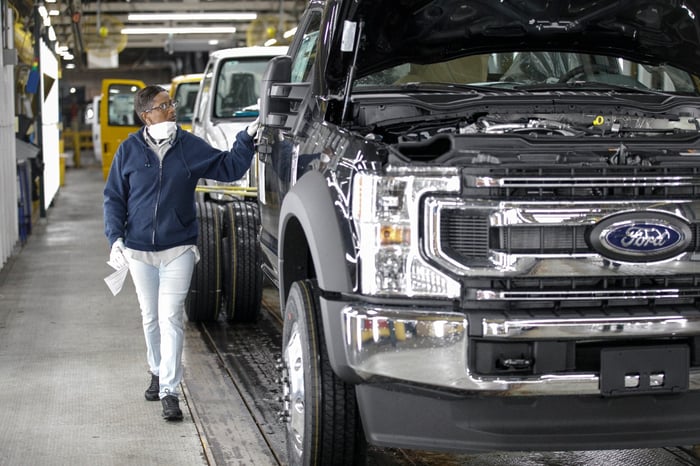
Image source: Getty Images.
Ford’s Dividend Journey
Ford is currently disbursing a quarterly dividend of $0.15 per share, totaling $0.60 annually. This rate has held steady since early 2023, when Ford increased its payout from $0.14. In addition to regular dividends, the company has issued several special dividends in recent years, including payments of $0.15 in early 2025, $0.18 last year, and $0.65 in 2023. These special payments have helped Ford aim for a target of returning 40% to 50% of its adjusted free cash flow to shareholders annually.
However, Ford’s dividend history isn’t without bumps. The automaker has suspended its payouts on two occasions: once in 2006 and again in 2020. After the first suspension, it took nearly six years for Ford to reinstate its dividend, and during the pandemic, the payout was halted for about two years.
What Lies Ahead for Ford’s Dividend?
Entering 2024, Ford was optimistic, closing out 2023 with record revenue. CEO Jim Farley remarked that “Ford is becoming a fundamentally stronger company,” pointing to a diverse product portfolio and the company’s leading market position through Ford Pro.
The company aimed for substantial improvements in quality and cost efficiency this year, anticipating $3.5 billion to $4.5 billion in adjusted free cash flow, even after allocating $8 billion to $9 billion for capital expenses that support growth. Despite being lower than $6.7 billion from last year, this figure would adequately cover their dividends, which totaled around $3.1 billion in 2023.
That said, considerable changes have occurred since the year began. Tariffs imposed by the Trump administration on various imported goods, particularly those crucial to the automotive sector, have compelled Ford to suspend its financial guidance for the first quarter, including forecasts for adjusted free cash flow.
On the bright side, Ford enters this uncertain era from a position of financial strength, with $27 billion in cash and $45 billion in liquidity by the end of the first quarter of 2024. CFO Sherry House stated that this “provides flexibility to continue to invest in profitable growth while managing current industry dynamics.”
Yet, in light of the tariffs potentially affecting earnings and cash flow significantly, it might be prudent for Ford to reconsider its dividend. Many analysts predict a possible reduction, with consensus opinions suggesting a drop to $0.12 per share. Some experts even argue that this may still be too high given the current economic climate. If conditions worsen—similar to past financial crises—Ford could decide to entirely halt dividends until the landscape improves.
Weighing the Risks for Income Seekers
With a yield over 5.5%, Ford undeniably presents an attractive dividend offer. However, the current economic climate hints that this high yield could resemble a trap rather than a genuine opportunity. Given the uncertainty surrounding tariffs and Ford’s inconsistent dividend record during turbulent periods, it may be wise for income investors to steer clear of this stock for the time being.
Matt DiLallo has positions in Ford Motor Company. The Motley Fool has no position in any of the stocks mentioned. The Motley Fool has a disclosure policy.